Enterprise contact centers sit at the intersection of customer experience, revenue protection, and brand reputation. They also operate under real constraints: high interaction volumes, complex products, seasonal demand spikes, strict compliance, and the constant challenge of hiring and retaining skilled agents. AI contact center solutions for enterprises are designed to help meet those demands by combining automation, real-time assistance, and analytics across voice and digital channels. When implemented thoughtfully, AI can reduce friction for customers, remove repetitive work for agents, and give leaders clearer visibility into what is happening across operations. A best omnichannel contact center ensures these advantages are delivered consistently across every customer touchpoint.
For planning and budgeting, reviewing enterprise AI contact center solutions pricing is crucial. Pricing can vary based on the scale of deployment, advanced AI features, integration requirements, and the number of users and interactions. Understanding these costs upfront helps enterprises align investments with operational goals, forecast ROI, and ensure that AI initiatives deliver measurable improvements in customer experience, agent efficiency, and overall business performance.
This guide breaks down what “AI for the contact center” actually means, where it delivers the biggest benefits, and how enterprises can adopt it in a way that is secure, scalable, and measurable.
What is an AI contact center solution (in enterprise terms)?
An AI contact center solution uses machine learning and natural language technologies to support or automate parts of the customer service lifecycle. In an enterprise setting, these capabilities illustrate how ai contact center automation is shaping modern contact centers. A complete solution typically includes:
- Customer-facing automation such as chatbots and voicebots for common questions and routine transactions
- Agent-assist tools that guide agents during live interactions with suggested responses, knowledge articles, and next-best actions
- Conversation intelligence that transcribes, summarizes, tags, and analyzes interactions for quality, coaching, and operational insights
- AI-enhanced routing to match customers to the best agent or channel based on intent, customer profile, and context
- Workforce and performance optimization features that help forecast demand, monitor quality, and scale consistent service
Enterprises usually deploy these capabilities in an omnichannel model, covering voice, chat, email, messaging, and sometimes social channels, while integrating with existing systems like CRM, ticketing, identity, and knowledge bases. This demonstrates the power of ai contact center software and the strategic value of contact center ai services in delivering intelligent, efficient, and scalable customer support.
Why enterprises are investing in AI contact centers
AI in the contact center is less about novelty and more about outcomes. Enterprise leaders typically pursue AI to improve three core areas:
- Customer experience: faster answers, fewer transfers, more consistent service, and smoother self-service.
- Operational efficiency: reduced handle time, better deflection for routine work, and improved capacity planning.
- Agent productivity and retention: less repetitive work, faster ramp for new hires, and better coaching based on real interaction data.
Because contact centers often handle high-volume, high-stakes interactions, even incremental improvements in speed, resolution, and consistency can create meaningful enterprise value.
Top AI Contact Center Solutions for Enterprises
AI contact center solutions help enterprises streamline operations, improve agent efficiency, and deliver personalized customer experiences at scale. By combining automation, real-time assistance, and advanced analytics, these platforms reduce costs, improve performance, and enhance customer satisfaction. Here are some of the leading AI contact center solutions tailored for enterprises:
1. Bright Pattern — Enterprise AI Contact Center Platform

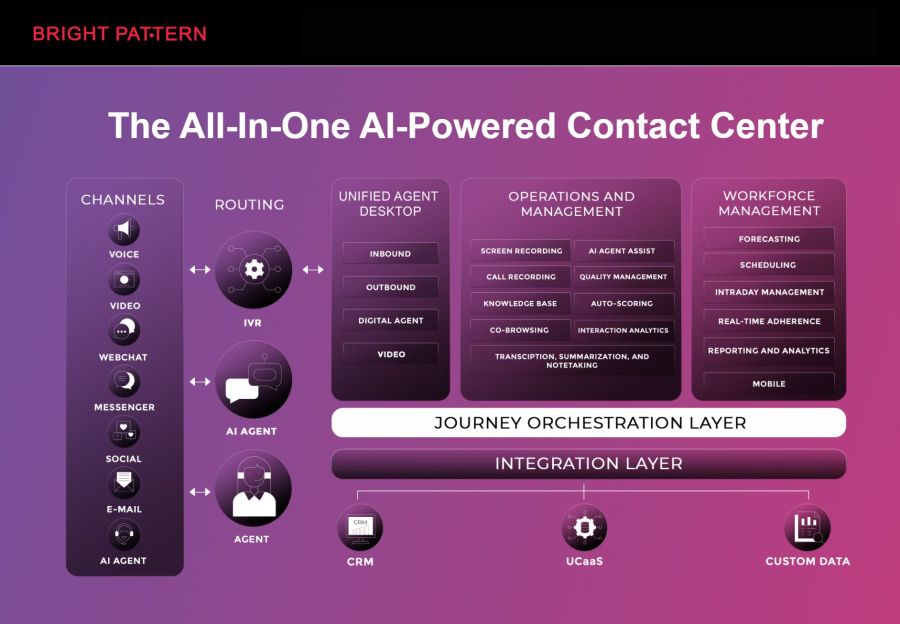
Bright Pattern is a comprehensive AI contact center platform designed for enterprise operations. Its solution combines automation, real-time agent assistance, omnichannel support, and advanced analytics, all within a scalable and secure environment.
Enterprise Features and Benefits:
- Automated Virtual Agents handle routine interactions like FAQs, billing inquiries, order tracking, appointment scheduling, and returns. This reduces operational costs and frees agents for complex cases.
- Intelligent Routing connects customers to the best agent based on skills, sentiment, history, and predicted needs, improving first-call resolution.
- Omnichannel Engagement allows customers to switch seamlessly between voice, chat, email, SMS, messaging apps, and video without losing context.
- Real-Time Agent Assistance provides suggested responses, knowledge base articles, next-best actions, and sentiment insights to agents, boosting efficiency.
- Workflow Automation manages repetitive tasks such as ticket creation, follow-ups, notifications, and surveys.
- Predictive Analytics tracks trends, sentiment, and agent performance, providing actionable insights for operational optimization.
- Integration Services connect seamlessly with CRM systems, workforce management tools, and enterprise applications.
- Proactive Customer Engagement automatically notifies customers of delays, updates, or promotions, reducing inbound contacts.
- Enterprise Scalability and Security support global operations with compliance-ready features and disaster recovery.
- Commercial ROI: Enterprises using Bright Pattern report reduced handle times, improved first-contact resolution, lower costs, and higher customer satisfaction.
Bright Pattern is ideal for large-scale operations seeking a reliable, scalable, and fully integrated AI contact center platform with measurable business impact.
2. Genesys Cloud CX
Genesys Cloud CX provides AI-powered routing, predictive engagement, and workforce optimization. Enterprises benefit from real-time analytics, journey mapping, and AI-assisted workflows.
3. NICE CXone
NICE CXone offers AI automation with workforce optimization, quality management, and predictive analytics. It improves agent performance, reduces handle times, and ensures consistent service at scale.
4. Talkdesk
Talkdesk provides virtual agents, workflow automation, and AI-assisted real-time guidance. Enterprises can automate routine tasks, optimize staffing, and deliver faster responses.
5. Amazon Connect
Amazon Connect integrates AI technologies like Amazon Lex and Contact Lens for virtual agent interactions, speech analytics, sentiment detection, and enterprise-scale automation.
6. Zendesk
Zendesk enhances enterprise support with AI ticket routing, conversational bots, and knowledge base recommendations, reducing agent workload and speeding resolution.
7. Microsoft Dynamics 365 Customer Service
Microsoft Dynamics 365 provides AI-assisted case routing, virtual agent support, and predictive insights, helping enterprises deliver efficient, personalized service.
8. Google Cloud Contact Center AI (CCAI)
Google CCAI offers enterprise AI services, including virtual agent orchestration, speech-to-text analytics, sentiment analysis, and customizable workflows.
9. Salesforce Service Cloud + Einstein AI
Salesforce Einstein enhances Service Cloud with AI case routing, predictive recommendations, workflow automation, and agent assistance, improving efficiency and customer satisfaction.
10. Five9
Five9 delivers AI-powered virtual agents, smart IVR, and real-time agent assist. Enterprises can automate repetitive tasks and optimize contact center operations.
High-impact AI capabilities (and what they do)
1) Intelligent self-service: chatbots and voicebots
Modern bots are designed to handle predictable, repeatable intents such as order status, appointment scheduling, password resets, shipping questions, and policy lookups. In enterprise environments, the best self-service experiences are:
- Context-aware, using identity or account signals when permitted.
- Integrated with systems of record so the bot can complete tasks, not just answer FAQs.
- Escalation-ready, transferring to a human with full conversation context.
The benefit is twofold: customers get faster answers for straightforward needs, and agents spend more time on complex, high-empathy, high-value interactions.
2) Agent assist: real-time guidance during live conversations
Agent assist tools support agents while they work. Depending on the platform, agent assist can:
- Surface relevant knowledge articles based on detected intent.
- Suggest compliant language for regulated processes.
- Recommend next steps, forms, or workflows.
- Provide real-time prompts for empathy statements or de-escalation techniques.
For enterprises, this can improve service consistency across teams and locations, particularly when product catalogs are large or processes are complex.
3) Automatic transcription, summaries, and wrap-up automation
After-call work (and after-chat work) adds up quickly in high-volume centers. AI can help by generating:
- Transcripts of voice conversations and chat logs.
- Interaction summaries that capture customer intent, key actions taken, and outcomes.
- Disposition suggestions and structured fields for CRM or ticketing updates.
When summaries are accurate and editable, agents can spend less time on documentation and more time helping customers.
4) Conversation intelligence for QA, coaching, and insights
Traditional quality assurance often relies on sampling a small fraction of interactions. Conversation intelligence broadens coverage by categorizing and analyzing interactions at scale. Enterprises use it to:
- Track drivers of contact volume (top intents, new emerging issues, policy confusion).
- Monitor compliance language and required disclosures.
- Identify coaching opportunities (for example, talk-to-listen ratio, interruptions, missed verification steps).
- Detect trends across products, regions, and customer segments.
This makes QA more data-driven and helps leaders prioritize operational improvements based on what customers are actually contacting you about.
5) Intelligent routing and prioritization
AI-assisted routing can use signals such as customer history, intent, language, or channel preference to route interactions more effectively. For large enterprises, smarter routing can:
- Reduce unnecessary transfers.
- Increase first-contact resolution by matching the right agent skills to the right need.
- Support priority handling for high-value customers or urgent intents, aligned to policy.
Routing improvements are especially valuable when products are specialized, support tiers are complex, or service levels differ across segments.
6) Proactive support and digital deflection
Some enterprises use AI to identify when customers are likely to need help and proactively offer support via digital channels. Examples include:
- Offering a guided help flow when customers repeatedly fail an online checkout step.
- Suggesting relevant FAQs or knowledge articles in-account before a call is placed.
- Triggering service notifications to reduce inbound “status check” contacts.
When done responsibly and with clear customer choice, proactive support can reduce preventable contacts and improve satisfaction.
Where enterprise teams see the biggest benefits
Customer experience wins
- Faster answers for common requests through 24/7 self-service.
- More consistency in tone and policy adherence across channels and teams.
- Smoother handoffs when bots transfer to agents with context intact.
Operational efficiency gains
- Lower workload on peak days by handling routine intents automatically.
- Reduced handle time when agents receive real-time knowledge and workflow guidance.
- Better visibility into volume drivers and repeat-contact causes.
Agent productivity and retention improvements
- Less repetitive work through automated summaries and documentation support.
- Faster onboarding for new agents with real-time coaching and suggested answers.
- Higher confidence when agents can quickly find accurate, approved information.
Common enterprise use cases by industry
AI contact center capabilities are broadly applicable, but enterprises often prioritize use cases based on regulatory requirements, customer expectations, and interaction complexity.
Financial services
- Account servicing and status inquiries
- Fraud-related guidance and secure verification flows
- Policy-compliant disclosures and scripting support
Healthcare and health services
- Appointment scheduling and reminders
- Benefits and coverage questions
- Routing to clinical vs administrative support pathways
Retail and e-commerce
- Order tracking, returns, and exchanges
- Promotions and product availability questions
- Proactive support for delivery issues
Telecommunications and utilities
- Outage and service disruption handling
- Billing explanations and payment arrangements
- Troubleshooting and guided diagnostics
B2B SaaS and technology
- Tier-1 technical support triage
- Knowledge surfacing from product documentation
- Case summarization and faster escalations to engineering
Example scenarios (how AI plays out in real operations)
The following examples are illustrative composites, showing how enterprises commonly use AI contact center solutions.
Scenario A: High-volume retail peaks
An enterprise retailer experiences seasonal spikes in “Where is my order?” contacts. A bot handles order-status lookups and delivery-date questions, while complex cases (damaged goods, address changes, exceptions) are escalated to agents with the full transcript and order details. Agents also receive auto-generated summaries for faster wrap-up. The result is quicker responses for customers and more available agent capacity for exception handling.
Scenario B: Regulated disclosures and consistent compliance
A regulated enterprise needs agents to provide specific disclosures and follow verification steps. Agent assist detects key moments in the conversation and surfaces approved language, reducing reliance on memory and helping standardize customer treatment across teams. Conversation intelligence supports QA by highlighting interactions that may need review based on policy triggers.
Scenario C: Faster support for complex B2B products
A global B2B support organization faces long ramp times for new hires. AI agent assist suggests relevant troubleshooting steps and knowledge articles based on the customer’s described issue. Summaries and structured case notes reduce time spent documenting, and analytics help leaders identify product areas generating the most contacts.
Key components of an enterprise-ready AI contact center
Enterprise buyers typically evaluate AI contact center solutions on more than features. The difference between a promising pilot and a scaled program often comes down to readiness in these areas:
Omnichannel consistency
Customers expect continuity across voice and digital channels. Enterprise platforms aim to preserve context, unify customer history, and apply consistent policies regardless of entry point.
Integrations with systems of record
To move beyond simple Q&A, AI must connect to the tools your teams rely on, such as CRM, ticketing, order management, identity, and knowledge bases. Strong integration support helps AI take action safely and correctly.
Knowledge management foundations
AI can only be as helpful as the information it can access. Enterprises benefit from:
- Curated, up-to-date knowledge articles
- Clear ownership and review workflows
- Approved content for regulated topics
Security, privacy, and governance
Enterprise deployments should include robust controls aligned to organizational requirements, such as:
- Access controls and role-based permissions
- Data handling policies for transcripts and recordings
- Encryption in transit and at rest
- Auditability for changes to configurations and knowledge sources
- Retention rules aligned to legal and operational needs
Depending on your industry and geography, you may also need to align with frameworks and regulations such as GDPR, CCPA, HIPAA, or PCI DSS. Requirements vary, so enterprises typically involve security, legal, and compliance teams early in the evaluation.
Reliability and scale
Large contact centers need predictable performance during spikes, high availability, and operational tooling for monitoring. This includes analytics dashboards, alerting, and clear operational ownership for AI configurations.
How to choose the right AI contact center solution
Enterprise evaluation works best when tied to measurable outcomes and real workflows. The checklist below can help teams move from feature comparison to decision clarity.
Evaluation questions that matter
- Use case fit: Which top contact reasons will you target first, and can the platform handle them end-to-end?
- Accuracy and control: How do you manage knowledge sources, approvals, and updates to keep answers reliable?
- Escalation design: How does handoff work from bot to agent, and is customer context preserved?
- Operational management: Can business teams tune intents, flows, and content without heavy engineering?
- Analytics depth: Can you track containment, resolution, transfers, and customer outcomes by segment and channel?
- Security posture: Are the controls and audit capabilities aligned to your enterprise standards?
- Global readiness: Do you need multilingual support, regional data handling, or local compliance alignment?
A practical requirements table
| Requirement area | What to look for | Why it matters |
|---|---|---|
| Self-service automation | Task completion, not just FAQs; smooth escalation | Improves customer speed while protecting experience for complex cases |
| Agent assist | Real-time suggestions, approved content, workflow guidance | Raises consistency and reduces handle time across varied skill levels |
| Summarization and wrap-up | Editable summaries, structured fields for CRM or tickets | Reduces after-call work and improves documentation quality |
| Conversation intelligence | Search, tagging, QA support, trend detection | Turns interactions into actionable coaching and process improvements |
| Integrations | CRM, ticketing, identity, knowledge, order systems | Enables AI to take safe actions and personalize support |
| Security and governance | RBAC, encryption, audit logs, retention controls | Supports enterprise risk management and compliance requirements |
Implementation approach: how enterprises adopt AI successfully
Enterprises often get the best results by treating AI as a program, not a one-time rollout. A phased approach can build confidence and deliver value quickly.
Phase 1: Prioritize high-volume, low-risk intents
Start with contact reasons that are common, well-defined, and have clear success criteria. Examples include status checks, simple account updates, or basic troubleshooting steps. This creates early operational wins and helps teams refine governance.
Phase 2: Add agent assist and wrap-up automation
Agent-facing AI can deliver immediate value without changing the customer entry experience. It also helps standardize knowledge usage and improve documentation, which strengthens downstream analytics.
Phase 3: Expand to advanced routing and proactive experiences
Once your organization has strong measurement and change management in place, you can layer in smarter routing and proactive support to reduce transfers and prevent avoidable contacts.
Phase 4: Operationalize continuous improvement
AI models and flows should be monitored and improved continuously. Enterprises often establish:
- Content governance for knowledge changes and approvals
- Analytics reviews to track shifting intent patterns
- QA workflows that combine human review with automated signals
- Feedback loops from agents and supervisors to refine recommendations
Metrics that demonstrate ROI (without relying on vanity numbers)
Enterprise stakeholders typically want a balanced view across customer outcomes, operational efficiency, and employee experience. Useful metrics include:
Customer outcome metrics
- First-contact resolution (by channel and intent)
- Transfer rate (especially bot-to-agent and agent-to-agent)
- Time to resolution for common issues
- Customer satisfaction trends by intent and segment
Operational efficiency metrics
- Containment for self-service flows (with quality safeguards)
- Average handle time (with attention to resolution quality)
- After-call work time
- Contact rate for repeat or preventable issues
Agent and quality metrics
- Time to proficiency for new hires
- QA coverage beyond traditional sampling
- Coaching effectiveness based on observed behavior change
For enterprise credibility, it helps to define success thresholds up front, align on measurement windows, and segment results by intent and channel so improvements are attributable to specific AI capabilities.
Building trust: making AI helpful, not frustrating
Great AI contact center experiences prioritize clarity and control. Enterprises can strengthen trust by focusing on:
- Transparent handoffs: if a bot cannot help, it should escalate quickly and pass context.
- Human-in-the-loop design: agents should be able to accept, edit, or reject suggested summaries and responses.
- Approved knowledge sources: keep responses grounded in current policies and documentation.
- Ongoing tuning: use analytics to improve flows, add missing intents, and remove friction.
When customers feel understood and agents feel supported, AI becomes a service multiplier rather than an obstacle.
What to do next: a clear starting plan for enterprises
If you are evaluating or expanding AI contact center solutions, a structured start reduces risk and accelerates value. A practical next-step plan looks like this:
- Map your top contact drivers by volume, cost, complexity, and customer impact.
- Select 3 to 5 pilot intents that are high-volume and well-defined.
- Align stakeholders across contact center ops, IT, security, legal, compliance, and customer experience.
- Establish governance for knowledge, access, retention, and change control.
- Define success metrics across customer outcomes, efficiency, and agent experience.
- Scale in phases, expanding to agent assist, analytics, and routing as operational maturity grows.
AI contact center solutions can help enterprises deliver faster, more consistent service while empowering agents to do their best work. With the right use cases, strong governance, and measurable goals, AI becomes a practical advantage in customer experience and operational performance.
